Modern businesses are increasingly moving away from static demographic targeting in favor of AI-driven customer segmentation. By analyzing behavioral patterns and predicting future actions, these tools allow companies to deliver personalized communication that reflects actual customer intent rather than broad generalizations.
This shift helps organizations optimize marketing budgets and improve engagement by responding to how individuals interact with a brand in real time.
AI Segmentation Tools and Their Core Capabilities
Effective customer segmentation relies on the ability to process complex data streams without requiring a dedicated team of data scientists. The current market features several platforms that offer distinct advantages depending on a company’s specific needs and data infrastructure.
These tools generally utilize one or more of the following methodologies:
- Behavioral segmentation:
Groups users based on specific actions, such as page visits, email interactions, or session frequency.
- Predictive segmentation:
Employs machine learning to forecast future outcomes, including potential churn, upgrade likelihood, or purchase probability.
- RFM segmentation:
Automates the calculation of Recency, Frequency, and Monetary value to identify high-value customers dynamically.
- CDP-based segmentation:
Aggregates data from multiple channels like apps, websites, and CRMs to create a unified customer profile.
How AI Performs Behavioral Analysis
AI-powered behavioral analysis evaluates how customers interact with websites, mobile applications, emails, and digital products. Instead of relying solely on demographic information, machine learning models examine browsing patterns, purchase history, feature usage, session frequency, and engagement signals to identify customer intent.
These insights help businesses build dynamic audience segments, predict future actions, and deliver personalized experiences based on actual behavior.
Comparison of Leading AI Segmentation Platforms
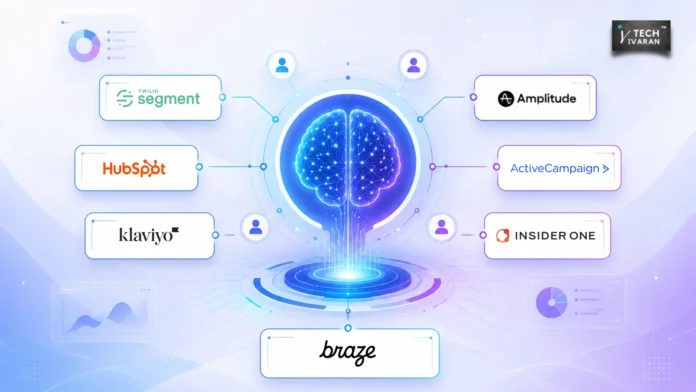
Selecting the right platform depends on the existing technical stack and the depth of data available. Each tool provides different strengths for various business sizes and industries:
- Segment (Twilio):
Designed for teams that need to unify data from over 450 sources before segmenting. It offers a free plan and starts at $120 per month.
- HubSpot:
Best suited for B2B and SMB teams already utilizing the HubSpot CRM. It features smart lists based on behavioral and CRM data, with pricing starting at $800 per month.
- Klaviyo:
Focused on ecommerce brands using Shopify or WooCommerce. It provides predictive analytics and RFM capabilities, with plans starting at $45 per month.
- Amplitude:
Ideal for product and growth teams requiring deep funnel and cohort analysis. Pricing begins at $49 per month.
- ActiveCampaign:
Targeted at SMBs looking for affordable email automation combined with predictive sending and lead scoring, starting at $19 per month.
- Insider:
An enterprise-grade solution for brands needing personalization across more than 12 channels, utilizing predictive segmentation and journey mapping.
- Braze:
Geared toward mid-market and enterprise B2C brands, offering a canvas flow builder and a comprehensive predictive suite.
Best Practices for Implementing AI Segmentation
The success of any AI-driven segmentation strategy is fundamentally tied to the quality of the underlying data. Before deploying these tools, organizations must ensure that information from disparate sources—such as websites, mobile applications, email platforms, and advertising networks—is clean and unified.
Incomplete or siloed data will inevitably lead to unreliable segments regardless of the sophistication of the machine learning model employed.
Dynamic segmentation offers a significant advantage over manual list management. When a customer shifts from a low-value to a high-value status based on their recent interactions, the system updates their segment automatically.
This capability allows for more precise communication, such as targeting users with a high probability of purchasing within a specific timeframe, which is far more actionable than broad, static demographic groupings.
Real-World Significance of AI-Driven Marketing
For businesses, the transition to AI-powered segmentation represents a move toward greater operational efficiency and improved marketing ROI. By automating the identification of behavioral patterns, companies can detect churn risks earlier and allocate resources more effectively.
Ultimately, these tools empower marketers to move beyond simple demographics, allowing them to engage customers based on their actual history and predicted future behavior.