
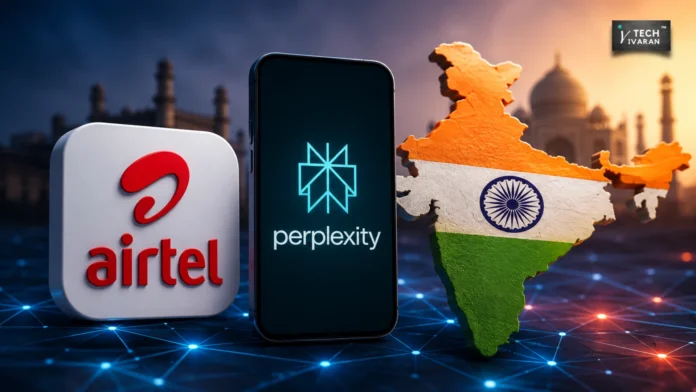
Perplexity offered Airtel customers a free 12-month Perplexity Pro subscription starting in July 2025, giving the company a large-scale opportunity to attract users in India. The results also provide insight into how offering a paid artificial intelligence subscription at no cost can affect user acquisition and long term monetization in a massive mobile market.
The Impact of the Airtel Partnership
In July 2025, Perplexity teamed up with Airtel to provide a free 12-month Perplexity Pro subscription normally valued at about $200 to the carrier’s 360 million customers. The offer was available to eligible Airtel customers across mobile, Wi-Fi, and DTH services.
New redemptions for this promotion officially wrapped up on January 16, 2026. Because each subscriber received 12 months of Pro access from the date they activated the offer, customers who claimed the promotion at different times will reach the end of their complimentary access on different dates.
The subscription can then automatically renew as a paid plan unless users cancel it before their individual free period ends.
The giveaway immediately shook up download numbers. Data shared by Sensor Tower revealed that Perplexity hit 5.9 million+ app downloads in India during July 2025. This marked a 625% jump from June 2025, surpassing the 5.4 million downloads the platform gathered during the entire first half of 2025.
Throughout the 7 month period from July 2025 through January 2026 that the promotion remained open to new users, Sensor Tower estimates that Perplexity recorded 56 million downloads, multiplying its previous 7 month figures by more than 9 times.
Monthly active users surged past previous levels as well, more than doubling to 8.9 million in July 2025 and eventually climbing to a peak of 22 million in October 2025.
Downloads Slow Down as Revenue Climbs
Once the window to claim the free Airtel subscription closed on January 16, 2026, new download rates dropped significantly. Sensor Tower estimated that Indian downloads fell to 3.3 million between February and July 2026, representing a drop of over 90% compared to the preceding 7 month stretch.
Even so, the user base proved resilient. Monthly active users stood at nearly 14 million in July 2026 – down 37% from the 22 million peak in October 2025, but still more than five times higher than the roughly 2.6 million monthly average recorded during the first half of 2025.
Surprisingly, the drop in downloads did not translate to a loss in revenue. Sensor Tower reported that in-app purchase and subscription earnings in India rose roughly 60% between February and mid August 2026, compared with the period when the Airtel offer was available to new users, even as downloads slowed.
From July 18 through August 12, 2026, daily in-app purchase revenue averaged 9% higher than the previous 30 days, and 27% above the average for the first half of 2026.
However, analysts note that these figures include auto-renewals, meaning it remains unclear whether former Airtel subscribers deliberately chose to pay or simply failed to cancel before their individual free periods ended. The increased visibility from the promotion may also have attracted paying users who were never part of the Airtel offer.
App intelligence firm Appfigures confirmed that the Airtel deal uniquely altered Perplexity’s growth trajectory compared to competitors like OpenAI’s ChatGPT and Anthropic’s Claude, whose download figures remained broadly stable during the same timeframe. In the week before the Airtel offer launched in July 2025, Perplexity averaged about 11,200 downloads a day in India.
That figure jumped to nearly 223,000 downloads a day during the first week of the promotion and later reached an average of about 305,000 daily downloads between mid September and mid October 2025.
| Period | Perplexity’s Estimated Net Mobile Revenue in India |
|---|---|
| January 2025 | $34,000 |
| December 2025 | $70,000 |
| July 2026 | $156,000 |
| January–July 2026 | $878,000 total |
Perplexity generated an estimated $878,000 in India during the first seven months of 2026, a 16% increase compared with its total revenue for all of 2025.