

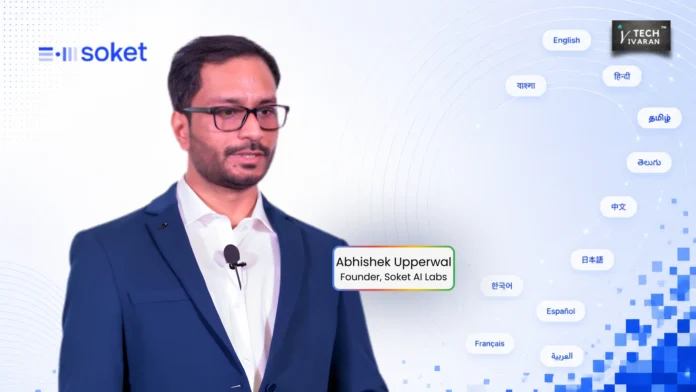
Soket AI Labs has announced the development of Project EKA, a 120 billion-parameter open-source foundation model. This initiative aims to provide advanced AI capabilities tailored for Indian languages and more than 20 other languages across the Global South, addressing a significant gap in current digital representation.
Project EKA Technical Focus and Reasoning Capabilities
The core objective of Project EKA is to move beyond simple language translation by embedding strong reasoning, mathematical, and coding skills directly into the model.
By prioritizing these analytical domains, the startup intends to create a system capable of solving complex problems that are relevant to enterprise, government, and strategic sectors.
Soket AI Labs is dedicating significant research efforts to refining its model architecture and data strategy. The company has spent approximately one year testing various approaches to ensure the model maintains a balance between high-level performance and operational efficiency, though specific architectural details remain undisclosed.
This focus on reasoning is intended to provide a foundation for critical infrastructure, including cybersecurity, finance, law, and scientific research.
By building an indigenous system, the company seeks to reduce reliance on international AI providers while ensuring that advanced coding and logic tools are accessible to non-English speakers.
Company Overview
| Founder | Abhishek Upperwal |
| Founded | 2019 |
| Headquarters | Gurugram, Haryana, India |
Data Strategy and Infrastructure Development at Soket AI
A major hurdle in the development of Project EKA has been the scarcity of high-quality datasets for under-represented languages.
To overcome this, the startup has developed its own specialized pipelines to collect, clean, and structure data, moving away from the reliance on large but low-quality public data sources.
Beyond the foundation model, the company is investing in orchestration infrastructure, which it refers to as harness engineering.
This layer is designed to manage the workflows and tooling necessary to connect raw AI intelligence to practical, real-world production environments, ensuring that the technology is ready for commercial deployment.
The startup has received support through the IndiaAI Mission, which includes both compute resources and non-compute assistance.
This backing is supporting the growth of the team, as the company adds specialized researchers and engineers to accelerate the development of both the foundation model and the accompanying orchestration stack.
Strategic Goals for Global South Language Integration
Soket AI Labs plans to launch Project EKA in 2027, with the intent of first perfecting the model within the Indian context.
Once the system demonstrates effectiveness across India’s diverse linguistic landscape, the startup plans to apply these same techniques to other language ecosystems globally that currently lack sufficient AI support.
The company views its work as a long-term effort to build a sovereign AI stack that is both scalable and broad enough for international application.
By aligning its foundation model layer with its internal orchestration tools, the startup aims to ensure that its research naturally transitions into reliable, enterprise-ready systems.
Project EKA represents a shift toward creating indigenous AI infrastructure that prioritizes the specific needs of under-represented populations.
By focusing on both linguistic diversity and high-level reasoning, the initiative seeks to establish a new standard for AI utility in regions that have historically been excluded from frontier technology development.