

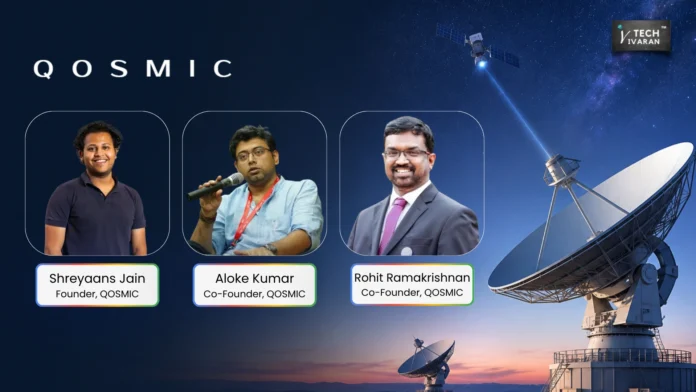
Bengaluru-based startup QOSMIC has announced a strategic shift in its operations, moving away from satellite manufacturing to focus exclusively on developing optical ground stations.
This pivot aims to address the growing data transmission bottleneck that currently plagues the global satellite industry, as legacy radio-frequency infrastructure struggles to keep pace with the massive volume of data generated by modern orbital constellations.
The urgency for this transition is driven by a significant disparity between data production and downlink capabilities. Modern satellites are now capable of generating between 1 and 2 terabytes of data daily, yet current radio-based systems often fail to capture more than a fraction of this information before the satellite moves out of range.
With the number of active satellites in orbit exceeding 11,700 as of mid-2025 and projections suggesting over 25,000 small satellites will be operational by 2030, the reliance on the crowded, aging radio spectrum has become a critical point of failure for the space economy.
The Technical Shift to Optical Communication
QOSMIC’s core offering centers on optical ground stations, which function as sophisticated, telescope-like systems designed to receive laser signals directly from satellites.
Unlike traditional radio-frequency ground stations, these optical systems utilize precision telescopes and advanced mechanical tracking hardware to facilitate high-speed data transfer.
By moving data transmission from radio waves to light, operators can achieve significantly higher throughput, effectively bypassing the limitations of traditional spectrum licensing and bandwidth constraints.
The technology relies on a complex chain of pointing, acquisition, and tracking, which allows for stable communication even as satellites orbit the Earth at high speeds.
QOSMIC claims to have developed proprietary intellectual property in this optical front-end stack, which it believes will allow for more cost-effective manufacturing compared to existing industry alternatives.
The startup has already validated its full optical chain through a 10-kilometer terrestrial link, achieving Technology Readiness Level 6 (TRL 6) in field testing.
Business Model and Market Strategy
Backed by $3.33 million in funding from investors including Accel, Prosus, South Park Commons, Art Garage, and various angel investors, QOSMIC is positioning itself as a service provider rather than a hardware vendor. Instead of selling its ground stations to third parties, the company plans to retain ownership of the infrastructure.
This approach allows the startup to build a distributed network of ground stations, charging satellite operators based on the volume of data transmitted.
This pricing strategy targets a significant reduction in costs for satellite operators. While current radio-frequency providers typically charge between $3 and $17 per gigabyte, QOSMIC aims to offer a flat rate of $1 per gigabyte at scale.
The company justifies this model by noting that optical downlink can move 10 to 100 times more data per pass than radio frequency, while utilizing ground hardware that remains comparable in cost.
By avoiding the recurring expenses associated with spectrum licensing, the company believes it can maintain profitability while offering competitive rates.
Leadership and Industry Context
The company is led by CEO Shreyaans Jain, who brings experience from the Indian Institute of Science (IISc), where he contributed to private satellite missions and projects associated with India’s Gaganyaan programme.
Alongside cofounders Prof. Aloke Kumar and Rohit Ramakrishnan the latter known for building one of the world’s earliest quantum satellites in Singapore Jain initially explored the potential for quantum communication.
However, the team realized that the immediate market demand was not for quantum-secure links, but for the fundamental optical infrastructure required to support high-volume data transmission.
QOSMIC is currently preparing for its next major milestone: in-orbit validation within the next year. To support this, the startup has entered a commercial collaboration with TakeMeToSpace, a company building orbital data centers. Together, the two firms are developing optical communication terminals that will interface with QOSMIC’s ground stations.
This partnership is intended to create what the companies describe as India’s first indigenous Optical Inter-Satellite Link network, with the first terminal launch scheduled for the second quarter of 2027.
Competitive Landscape and Future Expansion
While the domestic Indian space ecosystem is still in the early stages of exploring optical communications, QOSMIC is targeting international satellite operators as its primary near-term customers.
The startup faces competition from global players including France’s Cailabs, Singapore’s Transcelestial, and the UK’s Archangel Lightworks. To expand its international presence, QOSMIC intends to collaborate with ground station operators worldwide, creating a broader network for satellite data downlinks.
By focusing on the “last mile” of the space data chain, QOSMIC aims to address a critical infrastructure gap. Backed by a team of 12, the startup is leveraging its proprietary optical tracking technology and data-as-a-service model to support next-generation satellite constellations as it prepares for its first in-space demonstration.