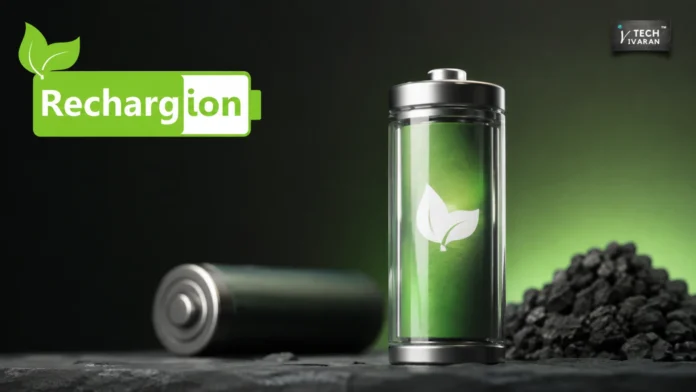
Rechargion, a Pune-based deep-tech startup originating from the CSIR-National Chemical Laboratory, has developed sodium-ion battery cells engineered to utilize raw materials that are readily accessible within India.
Established in 2021, the firm addresses local battery manufacturing challenges by focusing on domestic resource utilization for energy storage solutions.
Company Overview
| Founders | Dr. Vilas Shelke, Dr. Manjusha Shelke, John Raymond Normanton |
| Founded | 21 May 2021 |
| Headquarters | Pune, Maharashtra, India |
Developing Domestic Sodium-Ion Cells
India heavily relies on imported lithium-ion cells along with their essential internal components like cathodes, anodes, and electrolytes, keeping supply chains tethered to a handful of external nations.
Sodium presents a practical alternative because it sits right below lithium on the periodic table, shares similar chemical behavior, and offers abundant domestic availability alongside cheaper complementary materials. Rechargion approaches the inherent weight and energy density trade-offs of sodium ions by focusing heavily on proprietary material engineering rather than just cell design.
The enterprise relies on its own patented hard carbon serving as the anode material where sodium ions move in and out, alongside proprietary electrode materials and sodium compounds.
A key component of their approach involves proprietary electrode engineering, which the founders identify as critical to enabling commercial viability. Because the design avoids cobalt and nickel while depending largely on locally accessible raw materials, the production costs remain significantly lower than lithium alternatives.
In 2023, the organisation projected a cost of 11 to 12 rupees per watt-hour alongside a projected battery lifespan ranging between 12 and 15 years. These figures were early projections made during the company’s pilot-development stage.
Safety Validation and Institutional Backing
Beyond cost advantages, sodium-ion chemistry brings inherent safety benefits, such as the ability to be discharged completely down to zero volts for transport without suffering damage, coupled with a reduced tendency for thermal runaway.
The startup has demonstrated various practical applications including solar energy storage presented to a United Nations Industrial Development Organisation delegation, a sodium-ion-powered bicycle, and a drone application.
Additionally, the firm established a dedicated sodium-ion cell fabrication pilot plant, which Rechargion describes as the first dedicated facility of its kind in the country. The pilot plant was inaugurated in June 2024.
In August 2025, the Automotive Research Association of India concluded a two-month evaluation of Rechargion’s cells at its Chakan facility, testing them under the IEC 62660 protocol.
The rigorous assessment covered mechanical shock, vibration, crushing, high-temperature endurance, short circuits, overcharges, and forced discharges, culminating in a validation report. This milestone marked Rechargion as the first Indian company to achieve ARAI safety-test validation for sodium-ion batteries under IEC 62660/IS 16893.
Institutional support has driven the venture through development and government channels rather than conventional venture capital, counting backing from the Ministry of Heavy Industries via the ARAI-AMTIF accelerator, UNIDO, the US-India Science and Technology Endowment Fund, Social Alpha, and the Venture Center at NCL.
The company previously raised a seed round of about $120,640 in March 2023 with Social Alpha. Currently, the team is working to scale manufacturing to 500 to 1,000 cells daily, marking a deliberate step toward addressing consistency and scaling production.