Renewable energy grids face a difficult timing problem as they expand. Standard short-term battery storage handles evening peaks quite well, but it cannot support a still or overcast week. Lithium-ion batteries become too expensive for long durations long before they stop working.
Karetic Energy is trying to solve this challenge using iron-air chemistry. The method works by rusting iron and then reversing the process to charge and discharge the cell. Since iron, air, and water are abundant and inexpensive materials, this approach uses abundant materials for long-duration energy storage.
Overcoming Technical Hurdles in Iron-Air Storage
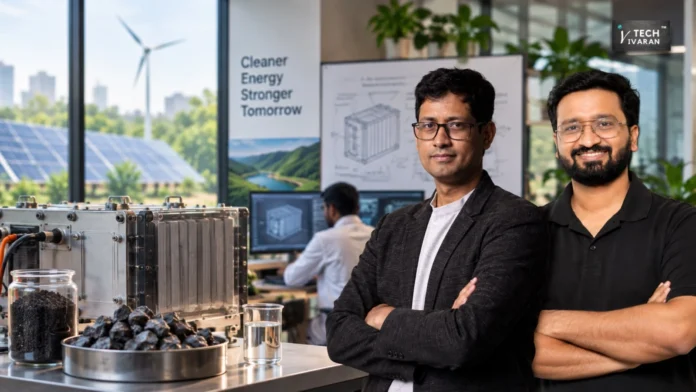
Dr Suryanarayana Vikrant Karra and Prabhakar Kumar founded Karetic Energy in 2025. The Delhi-based company is developing a rare-earth-free, non-flammable aqueous battery platform aimed at grid-scale, long-duration storage needs.
Using rare-earth-free materials means the supply chain avoids the few countries that handle the refining of those elements. The company describes the non-flammable chemistry as a safety feature for large-scale battery installations.
The engineering challenge with iron-air systems involves unwanted side reactions. Pushing current through an iron electrode in water often causes the water to split and produce hydrogen instead of doing useful work. The iron surface also tends to form a passivating layer that stops the reaction entirely.
To fix this, the startup uses an iron-particulate bed architecture designed to suppress hydrogen evolution and surface passivation. Under laboratory conditions, this setup has achieved continuous discharge cycles ranging from 100 to 145 hours. The company states that this method comes at a significantly lower capital cost than lithium-ion technology.
Moving Toward Utility Trials
A 100-hour discharge duration represents more than four days of continuous operation under the tested conditions. Karetic Energy intends to target utility-scale storage, industrial microgrids, and renewable farms with its modular and pilot-ready systems.
The startup has reported raising about 0.7 million dollars in funding alongside 0.3 million dollars in grants. It was also selected for Bharat Innovates 2026, a government program that brought Indian deep-technology companies to Nice, France, in June to connect with utility partners and integration opportunities.
The company is roughly eighteen months old, and its current performance metrics come from laboratory settings rather than field tests. While the firm positions its platform as ready for utility trials, it has not yet announced any official pilots, customers, partners, or independent test results.