
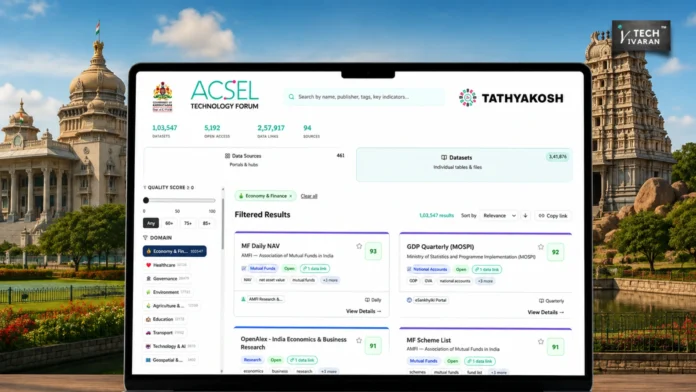
The Government of Karnataka has officially launched Tathyakosh, a centralized digital platform designed to streamline how users locate and access public information.
Developed by the Centre of Excellence in Artificial Intelligence and the ACSEL Technology Forum, the portal acts as a discovery layer rather than a storage database, allowing users to find relevant information without searching across multiple government websites and repositories.
Aggregating Vast Public Data
Launched in Bengaluru on August 12, 2026, the platform debuted with over 1.5 million distinct datasets sourced from 458 different repositories. Karnataka IT-BT Minister Priyank Kharge introduced the tool at Vikas Soudha, emphasizing its role as an open, non-commercial Digital Public Good intended to support India’s growing AI ecosystem by making existing institutional data more discoverable.
The interface currently organizes information across 16 diverse sectors, including agriculture, health, infrastructure, and the economy. Its index incorporates 346 Indian sources alongside 37 international repositories containing data relevant to the country.
Users can filter these datasets based on specific criteria such as file format, subject area, time period, and geographic location, with records extending back to 1947.
Quality Assessment and Accessibility
To assist users in determining the utility of the information, Tathyakosh provides an assessment for each entry based on seven dimensions, including findability, completeness, granularity, freshness, and machine-readability.
According to the launch details, approximately 92% of the indexed datasets are available as open access, while 95% are provided in machine-readable formats suitable for computational tools.
The platform maintains a strong focus on Karnataka-specific information, with more than 50,000 datasets from sources like the Karnataka Open Government Data Portal, the Indian Institute of Science, and the Raman Research Institute already included. While Tathyakosh facilitates the search process, it does not host the files directly; instead, it directs users to the original source to access the underlying data.