

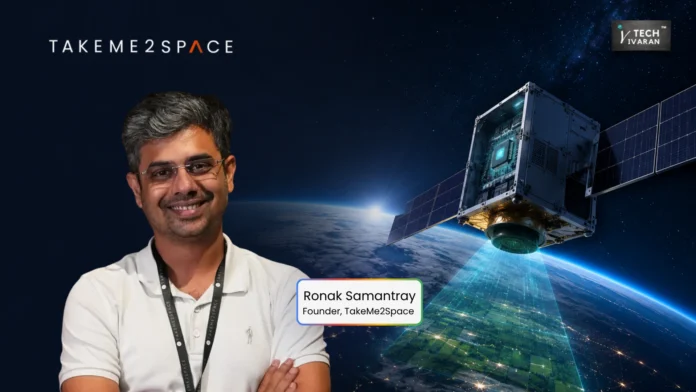
Hyderabad-based startup TakeMe2Space is preparing for a critical October launch via SpaceX, marking an important milestone in its effort to transform satellites from simple data collectors into sophisticated orbital processing units.
Following the loss of its initial payload during a failed PSLV-C61 mission in January, the company is eager to demonstrate the commercial potential of its compute-enabled satellite infrastructure.
By adding NVIDIA GPU technology directly into orbit, the firm aims to process vast amounts of satellite imagery locally, bypassing the traditional, bandwidth-heavy requirement of transmitting raw data back to Earth.
The Economic Logic of Orbital Computing
The main idea of TakeMe2Space is based on the inefficiencies of current Earth observation workflows.
Founder Ronak Samantray, who previously built the SaaS startup NowFloats, observed during the pandemic that while his revenue plummeted, his cloud infrastructure costs remained largely static. This experience highlighted the requires significant resources nature of terrestrial data centers, which require significant land, power, and cooling.
Samantray argues that if satellites are already generating terabytes of imagery in orbit, the next step is to process that data at the source rather than downloading it for analysis on the ground.
Critics have long questioned the need of moving computing hardware into the harsh environment of space when terrestrial data centers are becoming increasingly efficient. However, Samantray argues that the goal is not to move all computing to space, but to solve a key challenge: the time and cost associated with transmitting raw data.
By running AI models in orbit, TakeMe2Space claims it can reduce transmission costs by up to 85% and reduce turnaround times for useful insights such as agricultural health indices or maritime vessel detection from several days to mere minutes.
Technical Infrastructure and the MOI-1A Satellite
Building a data center in space requires operating in the harsh conditions of space, including intense radiation, thermal management issues, and the lack of physical maintenance opportunities. To address these, TakeMe2Space has developed a several proprietary technologies.
These include RadShield, a radiation protection material designed to protect data-center-grade GPUs, and custom thermal extraction systems. The company is also engineering high-energy power electronics and lightweight satellite structures to ensure continuous operation without human intervention.
The startup’s primary satellite, the MOI-1A (My Orbital Infrastructure), acts as a flying compute node. It features a 117 TOPS (trillion operations per second) AI processor paired with 16 GB of onboard memory.
Additionally, the satellite carries a nine-band multispectral imaging payload capable of nine-meter ground resolution. This hardware allows the satellite to perform real-time analysis, effectively turning the craft into an edge computing device that delivers processed insights directly to the end user.
OrbitLab and the Software-Defined Satellite
Beyond hardware, TakeMe2Space has developed OrbitLab, a web-based software platform designed to democratize access to orbital computing.
The interface allows developers to track satellite orbits in real time, define areas of interest, and upload their own AI models to a sandbox environment for validation before deployment.
By supporting multiple deployment formats, the platform allows clients to utilize existing machine learning workflows without needing to learn space-specific programming languages.
This infrastructure-focused approach is central to the company’s business strategy. Samantray emphasizes that the firm does not build its own AI models, as doing so would create a conflict of interest with its customers.
Instead, the company positions itself as a neutral provider, enabling research institutions, universities, and commercial enterprises like Tiger Analytics to deploy their own proprietary algorithms.
This strategy differentiates TakeMe2Space from other players like Pixxel, which is working with Sarvam AI to run specific models on its own orbital data center satellites.
Scaling the Constellation and Future Outlook
The upcoming October launch is the first step in a broader roadmap. TakeMe2Space is currently seeking to raise between $50 million and $55 million in a Series A funding round to finance a six-satellite constellation.
This fleet would allow for continuous service, moving away from the intermittent coverage currently provided by a single unit. The company also plans to enhance its software capabilities and develop higher-power compute platforms, with solar cell and optical inter-satellite link technologies targeted for 2027.
Access to space remains the biggest challenge for the startup, as evidenced by the setback caused by the PSLV-C61 failure.
However, the emergence of Indian private launch providers like Skyroot Aerospace and Agnikul Cosmos offers hope for a more reliable, consistent frequency of launches.
As TakeMe2Space prepares to launch its next payload, the industry is watching closely to see if the firm can prove that orbital computing is not just a niche research experiment, but a commercially viable part of the global digital infrastructure.