
OpenAI has officially ventured into the hardware space with the release of Micro, a specialized keypad designed to integrate directly with ChatGPT and the company’s Codex coding tool. Developed in partnership with boutique keyboard manufacturer Work Louder, the device aims to provide power users with a tactile interface for managing AI-driven tasks.
This launch marks a significant, albeit controversial, expansion for the AI lab, which is currently navigating a high-profile legal battle with Apple regarding allegations of trade theft.
Design and Functionality of the Micro Keypad
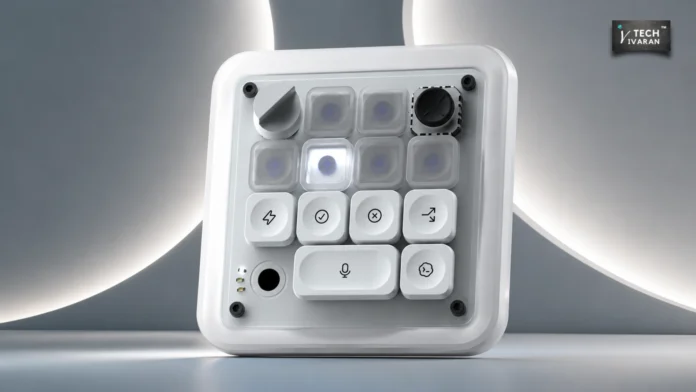
The Micro hardware features a distinct layout consisting of six customizable “agent” keys at the top, intended for executing specific commands within ChatGPT or Codex, and six command keys for broader program control. Users can connect the unit to their computers via Bluetooth or a standard USB cable.
A standout feature is the dedicated voice dictation button, which allows users to speak requests directly to the AI, followed by a send button to submit the prompt for processing.
Customization is handled through a dedicated tab within the ChatGPT interface, where users can adjust key assignments, project mapping, and the brightness of the built-in lighting.
The device relies on a color-coded notification system to communicate status: white indicates an idle agent, blue signifies the AI is processing, green confirms task completion, and red alerts the user to an error.
Mastering these indicators, alongside the specific key mappings, is essential for integrating the device into a daily workflow.
Meet kbd-1.0-codex-micro, built with @work_louder.
Map the buttons and joystick to your workflow, and keep your pinned chats in view.
Get yours before stock returns 410. pic.twitter.com/MGQQ1ISW0l
— OpenAI Developers (@OpenAIDevs) July 15, 2026
Developer Reception and Market Positioning
Despite its sleek, minimalist aesthetic, which some observers say resembles Apple’s design language, the $230 price tag has drawn sharp criticism. Many developers have expressed skepticism, with some labeling the device a novelty rather than a functional tool for professional programming.
Reviews from independent outlets and online forums have questioned the value proposition of the hardware, particularly when compared to more affordable DIY or off-the-shelf macro pad alternatives.
While the learning curve is steep, the device offers potential efficiency gains for those deeply embedded in the ChatGPT ecosystem, such as the ability to toggle between various project sessions with a single press.
However, for the average user, the utility of the keypad remains a subject of debate, as many find traditional mouse and keyboard setups more intuitive.
OpenAI continues to explore broader hardware ambitions, including the development of other smart home products reportedly spearheaded by former Apple engineers, as it seeks to define its role in the physical technology landscape.